OPERATE - DURING THE EXHIBITION
- How to Plan Your Booth Operation
- How to Connect with Visitors
- How to Collect & Summarize Visitor Information
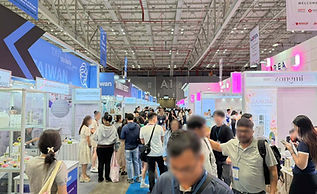
Once the booth design and construction are complete, the booth enters the actual operation phase. This is when the space is put into use, allowing the company to directly meet visitors, introduce its products, and engage in conversations through out the exhibition.
Operation is not simply about maintaining the booth’s activities; it is about how the space, people, and content come together throughout the exhibition. From creating the initial point of contact to maintaining engagement and capturing information, each activity should be organized in a way that aligns with the company’s objectives.

Plan

Connect

Collect
1. How to Plan Your Booth Operation
Define Objectives
Define the main objectives of the exhibition: introducing products, finding custom ers or business partners, maintaining relationships, or gathering market information. Based on these objectives, identify priority visitor groups and the key content to focus on.
Assign Staff Roles
Determine who will be responsible for welcoming visitors, introducing products, supporting visitor experiences, handling in-depth discussions, and recording infor mation. Each team member should clearly understand their role and how to coordi nate with others when necessary.
Prepare for Booth Activities
Check all necessary materials and items, such as brochures, business cards, pens and paper, drinking water, giveaways, and items needed for interative activities.
Stay Flexible
The plan should serve as a general guideline, not a fixed script. Staff assignments and approaches should be adaptable to visitor volume, timing, and the actual situation at the booth.


2. How to Connect with Visitors
Once a conversation has started, it is important to create an experience that encour ages visitors to continue exploring. At this stage, the content and how the booth is organized play a more important role than simply atiracting atiention.
Capture Atiention
When entering an exhibition area, visitors are often moving through the space while observing the surrounding booths. Therefore, before staff approach them, the booth should already create a clear enough first impression.
The point of attraction can come from the booth’s form, height, lighting, colors, graphics, displayed products, or brand messaging. The goal is not to make the booth stand out at all costs, but to help visitors quickly recognize what makes it more appealing than the spaces around it.
Create a Point of Engagement
Once attention has been captured, there should be a point of engagement that encourages visitors to come closer. Depending on the objectives, this could be a featured product, an experience area, informational materials, giveaways, or an interactive activity.
For suitable products, quick questions, short games, mini-games, or challenges can create additional opportunities for visitors to participate. However, the activity should be relevant to the brand or product so that participation can naturally devel op into a conversation.
Turn Attention into Conversation
Once visitors have stopped, staff should not focus solely on presenting information. Observing, asking questions, and listening can help identify what visitors are inter ested in.
Based on this understanding, the conversation can be adapted more appropriately instead of using the same approach with every visitor.
Create a Relevant Experience
Not every visitor needs to be approached in the same way. Some may need an overview, others may want to see the product directly, while visitors with specific needs may require a more in-depth discussion with the appropriate staff member.
Adapting the approach to each type of visitor helps make the interaction more natural and better aligned with the company’s objectives.
Our Featured Projects
Explore more our exhibition projects and see how we bring ideas to life

Vietbeauty Cosmobeaute Vietnam 2026
Cosmobeaute Malaysia&beautyexpo 2026

MTA Hanoi 2026

3. How to Collect & Summarize Visitor Information
During the exhibition, each interaction can provide different insights into visitors’ needs, areas of interest, or potential for further communication. If only contact information is recorded, it may be difficult for the company to recall the context of each interaction after the event ends.
Choose the Right Method for Information
Collection Information gathering should not begin only after the conversation has ended. In addition to contact details, it can be useful to record areas of interest, needs, prod ucts discussed, or topics that require further follow-up.
Depending on the communication methods and systems used at each exhibition, information can be collected through business cards, email, QR code scanning, or the organizer’s attendee information collection app.
Keep Track of Each Interaction’s Context
As the number of visitors increases, contact information alone may not be enough for the company to remember each interaction. Recording additional details from the conversation helps the team understand why a particular connection is worth following up on and how to move the conversation forward.
Consolidate the Collected Information
Consolidation does not necessarily have to wait until the exhibition ends. Classifying and consolidating the information collected allows the company to review its connections more easily, assess their level of interest, and consider the next steps for follow-up.
In this way, OPERATE does not simply end when the exhibition closes. What is created during the operation phase — from meetings and conversations to the information gathered — can become the foundation for future connections.
An exhibition booth is the result of multiple interconnected stages, from defining objectives and preparing before the exhibition to design, construction, operation, and continued engagement after the event. Each stage has its own role, but cannot be separated from the process as a whole.
This is also how we approach exhibition booth implementation: rather than focusing solely on a completed space, we look at the entire process to ensure that each element is implemented appropriately, consistently, and with the company’s objectives in mind.